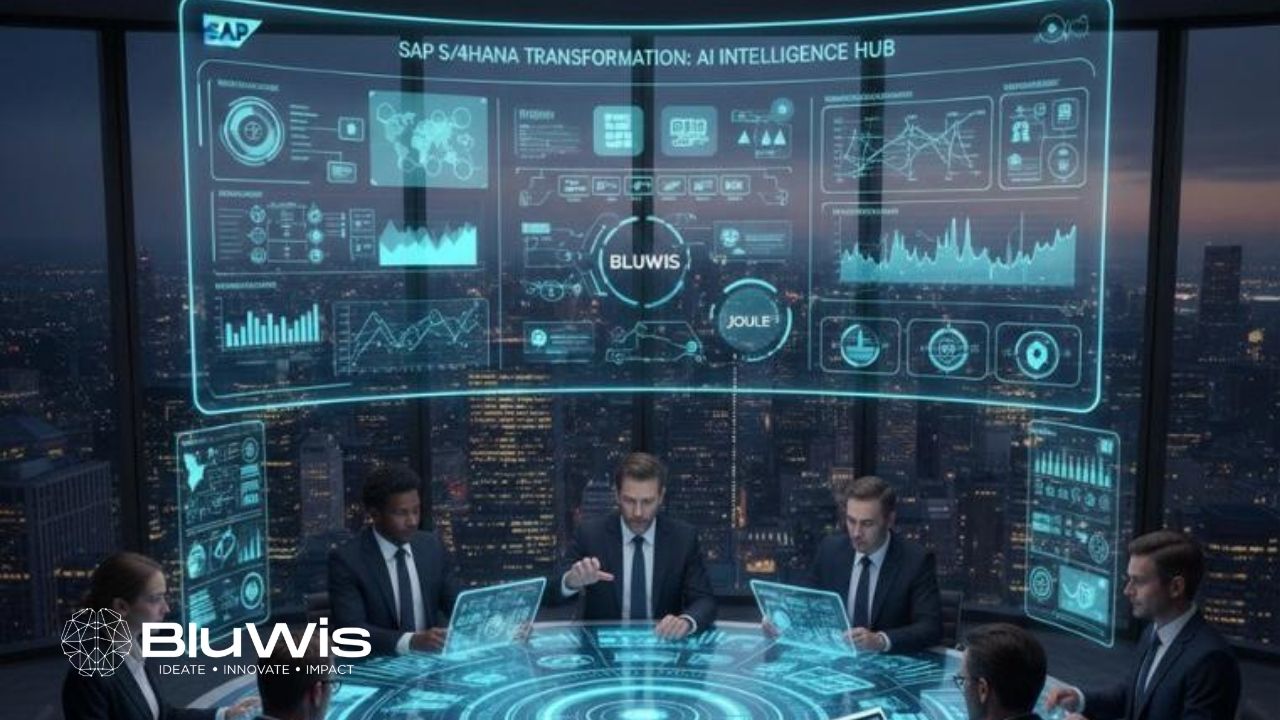
Over the past several weeks, we’ve focused our LinkedIn series from BluWis on a simple but urgent theme: The PMO must evolve. We’ve explored why traditional SAP PMO structures that are rooted in waterfall governance, greenboard status dashboards, and rigid controls may be misaligned with the demands of modern S/4HANA and digital transformation programs. Essentially, PMOs must evolve because the environment has changed.
But what exactly changed in the environment to make that evolution necessary?
The Environment Is Now AI-Shaped
Enterprise execution today operates in an AI-accelerated world. Decisions move faster. Data volumes are exponential. Business models shift in quarters, not years. AI is reshaping how enterprises operate; from predictive finance to intelligent supply chains. SAP itself is embedding Business AI and capabilities like Joule directly into core ERP workflows. SAP programs today no longer sit in static environments. They exist inside ecosystems of constant, data-driven recalibration. AI has raised expectations on how decisions are made inside enterprises. Leaders now expect predictive insight, scenario modeling, and real-time visibility especially within SAP-driven transformations.
If the enterprise is becoming intelligent and predictive, the PMO cannot remain mechanical and retrospective. AI is not a hype but is an operating infrastructure. The evolution of the PMO is therefore not an option but is a need of the hour in response to an AI-shaped operating reality.
The Shift Is Already Happening Inside SAP
SAP’s direction is clear: AI is being embedded directly into business processes, analytics, and enterprise workflows. This matters enormously for PMOs because when AI becomes embedded in ERP, analytics, finance, supply chain, and HR processes, the PMO gains something it has historically lacked: real-time, predictive visibility into enterprise execution.
The modern PMO is no longer limited to collecting updates. It can begin interpreting patterns.
How BluWis Leverages AI for the Modern PMO
The fact is that AI does not replace PMO leadership, it enhances it. Let’s look at how BluWis helps organizations move from reporting-driven PMOs to intelligence-enabled PMOs and what that looks like in practice:
1. Reducing Noise Through Intelligent Signal Detection
Large SAP programs generate overwhelming data encompassing risks, issues, logs, metrics, escalations. BluWis leverages AI to identify emerging deviations from business intent highlighting patterns, risk clusters, and delivery signals before they escalate. This results in less reporting noise and more execution clarity.
2. Predicting Impacts Before Slippage Occurs
Traditional PMOs explain slippage after it occurs. BluWis enables predictive analytics across SAP S/4HANA programs by identifying delivery risks, adoption gaps, financial deviations, and operational impact trends early.
This shifts the PMO from reactive governance to predictive and proactive intervention. The question moves from “What went wrong?” to “What is likely to go wrong and how do we intervene early?”
3. Enabling Data-Driven Trade-Off Decisions
AI-driven scenario modeling allows leadership teams to evaluate cost, timeline, and operational impact before locking decisions. BluWis embeds decision intelligence frameworks into the PMO operating model enabling structured trade-offs across speed, risk, and value, allowing the PMO to improve strategic alignment.
4. Augmenting Human Judgment
Perhaps most importantly, AI augments human leadership. PMOs still require business context, industry nuance, political awareness, and change sensitivity. AI provides insight; leadership applies judgment. The future PMO is intelligence-enabled and not robotic.
5. AI Admin: Automating Scrum & Execution Operations
One of the most immediate value areas is administrative automation. BluWis leverages AI to:
- Automate Scrum documentation
- Track follow-ups and task completion
- Generate meeting summaries and action logs
- Identify dependency bottlenecks
- Monitor sprint health across workstreams
This reduces manual overhead and frees PMO leaders to focus on strategic orchestration rather than administrative tracking. This leads to improving execution discipline without adding governance friction.
Why This Matters Now
SAP transformations today are simultaneous and interdependent with cloud migration, AI adoption, clean core initiatives, data harmonization, regulatory compliance. This complexity cannot be governed effectively through spreadsheets and after-the-fact reporting. Without intelligence embedded into execution, PMOs risk being seen as bureaucratic enforcers. However, with intelligence, they become strategic partners.
Where We Go Next
The shift toward AI-enabled execution is already underway. The question is not whether PMOs will change but how intentionally will they lead that change.
At BluWis , we are actively helping clients rethink how PMOs leverage intelligence, data maturity, and predictive insight to drive transformation outcomes. The future belongs to PMOs that combine strategic discipline with predictive capability and business alignment. The next frontier is clear: AI-enabled PMOs that combine strategic governance, predictive analytics, and business alignment.
In the coming weeks, we’ll explore:
- How AI changes risk management in SAP programs
- What predictive adoption tracking looks like
- How data maturity impacts PMO intelligence
- And what an AI-ready PMO operating model requires
Because the future PMO doesn’t just track transformation, it interprets it, anticipates it and enables it.
#SAP #S4HANA #PMO #BluWis #EnterpriseTransformation #DigitalTransformation #BusinessAI #ProgramManagement #ExecutionExcellence