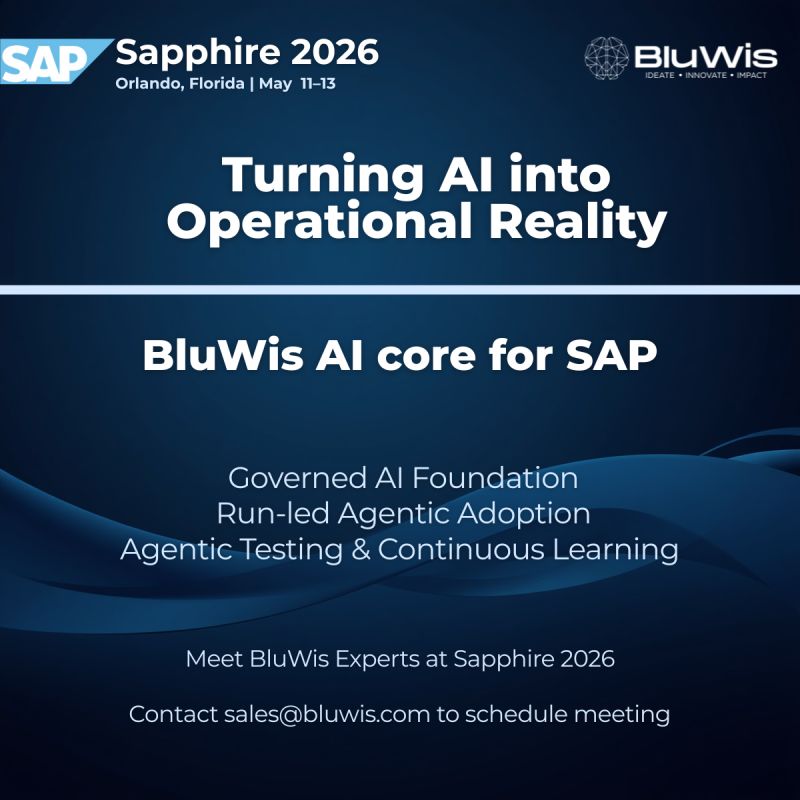
Turning AI Into Operational Reality: Why SAP’s AI Future Depends on Execution
From AI Vision to AI in Run
As organizations prepare for SAP Sapphire 2026, one thing is becoming increasingly clear: AI is no longer an add-on capability. It is rapidly becoming part of the operating layer of the enterprise.
SAP is driving this transformation through enterprise AI, intelligent workflows, automation, and increasingly autonomous operational models. The strategic vision is compelling.
But inside many large enterprises, the operational reality looks very different.
Across SAP S/4HANA transformation programs, execution often continues to follow traditional delivery models:
Large manual teams
Effort-based execution
Fragmented operations
Reactive support structures
Risk-averse transformation governance
AI is discussed extensively during:
Strategy sessions
Executive presentations
Transformation proposals
Innovation workshops
Yet when delivery begins, organizations often revert to familiar operational patterns.
The result is a growing disconnect between AI vision and AI in SAP operations.
For enterprise leaders, the challenge is no longer whether to adopt AI, but how to successfully operationalize AI in SAP operations without compromising stability, governance, or trust.
This is not simply a technology gap.
It is an execution gap.
Closing that gap requires enterprises to move beyond AI experimentation and establish practical operating models for introducing intelligence into mission-critical SAP environments.
The Shift From AI Vision to AI in SAP Operations
In conversations with enterprise leaders, one theme consistently emerges:
AI adoption inside core SAP operations remains limited.
That hesitation is understandable.
SAP environments power critical enterprise functions including:
Finance
Supply chain
Procurement
Manufacturing
Compliance
Enterprise operations
The cost of disruption is high.
Organizations cannot afford uncontrolled experimentation within mission-critical systems. A failed AI experiment in a standalone innovation environment may have limited consequences. The same failure within a core operational process can create financial, compliance, customer, or supply chain risk.
Moving from experimentation to scalable AI in SAP operations requires organizations to connect innovation with the realities of mission-critical enterprise environments.
This is precisely why enterprise AI adoption must begin where trust can be built first:
Run Operations.
At BluWis Technologies, we believe the path toward AI-driven SAP operations should prioritize:
Control
Governance
Operational stability
Measurable outcomes
Incremental adoption
before large-scale autonomy.
The objective is not to delay innovation. It is to create the foundations that allow innovation to scale responsibly.
Why SAP AI Adoption Must Start With Governance
One of the biggest misconceptions in enterprise AI is the assumption that intelligence alone creates transformation.
In reality, scalable AI in SAP operations depends on governance first.
Before deploying AI into SAP landscapes, organizations must establish:
Governance frameworks
Access boundaries
Auditability controls
Human-in-the-loop oversight
Security guardrails
Compliance visibility
Clear escalation paths
Defined decision rights
Without these foundations, AI can increase operational risk rather than reduce it.
An AI system may be capable of recommending an action, generating a response, or initiating a workflow. But enterprise environments require clarity around who—or what—is authorized to make decisions, access sensitive information, and execute operational changes.
This is particularly important in SAP environments where processes may involve financial controls, regulatory requirements, sensitive enterprise data, or business-critical dependencies.
A strong governance foundation is therefore essential for scaling AI in SAP operations safely across complex enterprise landscapes.
Governance should not be treated as a barrier to innovation. Done correctly, it becomes an enabler of sustainable adoption.
The stronger the governance foundation, the more confidently organizations can expand AI capabilities across enterprise operations.
Operational Use Cases Are the Real Starting Point
The most effective AI transformations rarely begin with large-scale autonomous initiatives.
They begin with operational pain points where measurable value can be created safely.
Early areas for AI in SAP operations can include:
Incident triage
Knowledge retrieval
Repeat issue resolution
Operational support automation
P1 and P2 incident management
Service desk acceleration
Root-cause analysis support
Knowledge-base creation and maintenance
These environments allow organizations to:
Build confidence
Validate governance
Improve operational efficiency
Reduce manual workload
Introduce AI incrementally
Measure business impact
without unnecessarily disrupting core business operations.
This makes Run Operations one of the most practical starting points for introducing AI in SAP operations and demonstrating measurable value.
Consider incident management.
Enterprise support teams often spend significant time reviewing tickets, searching historical resolutions, identifying similar incidents, routing issues to the correct teams, and manually compiling context.
AI can help accelerate these activities by analyzing historical information, identifying patterns, retrieving relevant knowledge, and supporting faster decision-making.
The value does not necessarily come from removing humans from the process.
It comes from giving enterprise teams better information, faster context, and more intelligent operational support.
This is where Agentic AI in SAP becomes highly practical.
From Automation to Agentic AI in SAP
Traditional enterprise automation is typically based on predefined rules.
If a specific condition occurs, the system executes a predetermined action.
Agentic AI introduces a different operating model.
AI agents can potentially interpret context, reason across available information, coordinate workflows, and execute defined tasks within established governance boundaries.
For SAP operations, this creates opportunities to move from isolated automation toward more intelligent operational orchestration.
An AI agent could, for example:
Analyze an incoming incident
Identify similar historical issues
Retrieve relevant knowledge
Recommend a resolution path
Route the issue to the appropriate team
Trigger an approved workflow
Escalate when human intervention is required
The key is not autonomy for its own sake.
The key is governed autonomy.
Enterprise AI systems must operate within clearly defined boundaries, with appropriate controls for security, compliance, auditability, and human oversight.
As adoption matures, AI in SAP operations can evolve from task-level assistance toward more intelligent and governed workflow orchestration.
That is what transforms Agentic AI from an interesting concept into a practical enterprise capability.
From Static Automation to Intelligent Testing
Enterprise testing is also undergoing a major transformation.
Traditional testing models rely heavily on:
Static automation scripts
Manual validation cycles
Reactive defect discovery
Repetitive execution models
Fragmented test evidence
These approaches can require significant effort to maintain, particularly as enterprise environments become more complex.
Modern AI-driven testing environments are evolving toward intelligent systems capable of:
Determining what should be tested
Prioritizing tests based on risk and change impact
Dynamically executing tests
Identifying defects proactively
Accelerating remediation workflows
Continuously improving through learning loops
Testing is another area where AI in SAP operations can create measurable value by improving risk identification, test prioritization, and operational feedback loops.
Testing is no longer only a project activity that happens before go-live. In continuously evolving enterprise environments, testing becomes part of an ongoing operational capability.
AI can help organizations move toward more adaptive testing models where testing priorities evolve based on system changes, business risk, historical defects, and operational patterns.
Importantly, this evolution still requires human oversight.
The objective is not replacing enterprise teams.
It is augmenting operational capability with intelligence, governance, and speed.
Introducing BluWis AI Core for SAP
At BluWis Technologies, we believe enterprise AI must be engineered for the realities of SAP environments:
High-control operations
Low-disruption execution
Measurable business outcomes
Enterprise-grade governance
Complex business processes
BluWis AI Core for SAP is designed as an agentic AI layer that operates securely within the client environment.
This approach is designed to help enterprises introduce AI in SAP operations through controlled, secure, and measurable adoption models.
The platform is built around three foundational principles.
1. Governed AI Foundation
Enterprise AI adoption must begin with trust.
A governed AI foundation establishes guardrails for:
Security
Compliance
Auditability
Operational oversight
Access control
Human intervention
from day one.
AI adoption without governance can create uncertainty and operational risk.
Governed AI creates the conditions for enterprise trust.
By establishing clear boundaries around how AI systems access information, make recommendations, execute tasks, and escalate decisions, organizations can create a more controlled path toward AI adoption.
This foundation is essential for scaling AI in SAP operations beyond isolated pilots.
2. Run-Led Agentic Adoption
The second principle is starting where AI can create practical and measurable value.
Run operations provide opportunities across:
Support automation
Incident management
Operational orchestration
Enterprise knowledge intelligence
Service management
Repetitive operational workflows
These areas allow organizations to introduce AI incrementally while maintaining control over mission-critical processes.
Instead of attempting enterprise-wide autonomy from day one, a Run-led approach enables organizations to identify specific operational use cases, establish measurable outcomes, validate governance, and expand based on demonstrated value.
By starting with clearly defined use cases, organizations can scale AI in SAP operations based on demonstrated value rather than unproven expectations.
This creates a more sustainable path toward Agentic AI in SAP.
3. Agentic Testing and Continuous Learning
The third principle focuses on transforming traditional testing assets into:
Intelligent testing environments
Adaptive automation systems
Continuous learning frameworks
AI-driven operational feedback loops
As enterprise systems evolve, testing must evolve with them.
AI-enabled testing can help organizations analyze changes, prioritize risk, improve test coverage, and create feedback loops between operational incidents and future testing decisions.
For example, recurring production issues can inform future testing priorities. Historical defects can help identify high-risk areas. Changes in business processes can dynamically influence test coverage.
This allows SAP operations to evolve continuously rather than through isolated modernization cycles.
Why the Future of SAP AI Depends on Operational Trust
The next generation of enterprise AI will not be defined simply by:
Model size
Chatbot sophistication
Automation volume
The number of AI pilots launched
It will be defined by:
Governance maturity
Operational resilience
Enterprise trust
Measurable outcomes
Sustainable adoption
Organizations that succeed will introduce AI into SAP landscapes without unnecessarily disrupting what already works, while steadily increasing operational intelligence over time.
Ultimately, the success of AI in SAP operations will depend on whether organizations can establish the trust required to expand AI responsibly.
This requires a different measure of AI success.
The question is not simply:
How much AI have we deployed?
The more meaningful questions are:
Has AI improved operational outcomes?
Can the organization trust how AI operates?
Can AI capabilities scale without introducing unacceptable risk?
That is the difference between AI experimentation and AI operationalization.
From AI Pilots to Sustainable Enterprise Adoption
Many organizations have already experimented with Generative AI.
The next challenge is moving from isolated pilots to sustainable enterprise adoption.
This transition requires organizations to connect:
AI strategy
Enterprise architecture
Governance
Operational processes
Data
Security
Business outcomes
A successful pilot proves that a technology can work.
Operational adoption proves that it can deliver value repeatedly, safely, and at scale.
For AI in SAP operations, this distinction is particularly important.
SAP environments are deeply connected to critical business processes. AI adoption therefore cannot be evaluated only on technical performance.
It must also be evaluated on operational reliability, governance, explainability, security, and measurable business impact.
The transition toward AI in SAP operations is therefore not a single technology implementation, but a gradual evolution of enterprise operating models.
The future of SAP AI will depend on the ability to bring all of these elements together.
Key Takeaways
AI is becoming an increasingly important operating layer of the enterprise.
Many SAP environments still face an execution gap between AI strategy and operational adoption.
Governance and trust must come before large-scale AI autonomy.
Run operations provide practical entry points for AI adoption.
Agentic AI in SAP can support more intelligent operational orchestration.
Intelligent testing systems represent an important evolution in SAP operations.
Sustainable AI adoption requires measurable outcomes, enterprise context, and strong governance.
Frequently Asked Questions
Why is AI adoption slower in SAP environments?
SAP systems manage mission-critical enterprise operations such as finance, supply chain, procurement, manufacturing, and compliance. Organizations require governance, auditability, security, and operational trust before introducing AI into core systems.
What is Agentic AI in SAP?
Agentic AI in SAP refers to AI systems capable of supporting or executing operational tasks, coordinating workflows, and acting within defined enterprise governance controls. The level of autonomy can vary depending on the use case, risk, and required human oversight.
Why should SAP AI adoption start with Run operations?
Run operations provide practical environments where organizations can validate governance, improve operational efficiency, measure outcomes, and build trust before expanding AI adoption into broader enterprise processes.
How can AI improve SAP testing?
AI can support risk-based test prioritization, change-impact analysis, intelligent test execution, defect identification, and continuous learning from historical testing and operational data.
What is BluWis AI Core for SAP?
BluWis AI Core for SAP is BluWis’s approach to introducing governed, operational AI capabilities into SAP landscapes through a secure agentic AI layer, Run-led adoption, and intelligent testing frameworks.
Conclusion: Turning AI Into Operational Reality
The future of SAP AI is no longer only about experimentation.
It is about operational reality.
As enterprises move toward intelligent operations, increasingly autonomous workflows, and AI-driven enterprise systems, the organizations that succeed will not necessarily be those deploying AI the fastest.
They will be the organizations introducing AI responsibly:
With governance
With operational trust
With measurable outcomes
With architectural discipline
With clear business context
At BluWis, we believe enterprise AI must evolve through controlled, governed, and operationally resilient adoption models that strengthen the enterprise rather than disrupt it.
The future of AI in SAP operations will depend not only on what AI can do, but on whether enterprises can trust it, govern it, integrate it, and translate it into measurable operational value.
Meet BluWis at SAP Sapphire 2026
Connect with BluWis at SAP Sapphire 2026 to explore how governed Agentic AI, intelligent testing, and Run-led operational transformation can help accelerate enterprise SAP modernization.
Book a Meeting