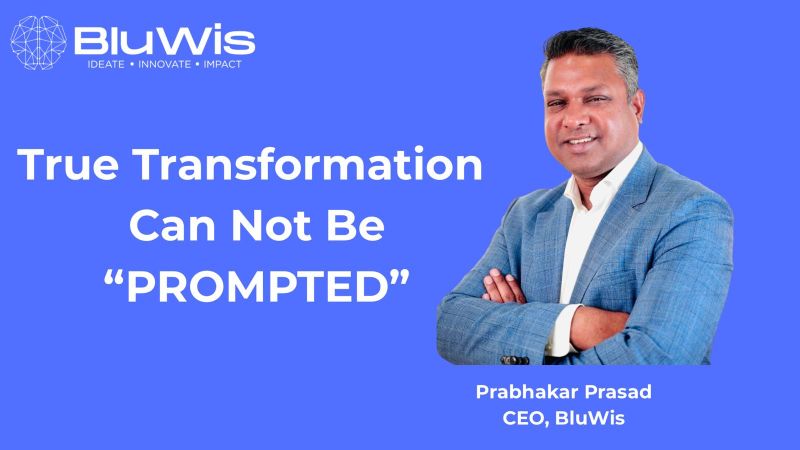
Generative AI can produce answers in seconds. But enterprise transformation is not created through prompts alone.
Real transformation requires process redesign, governance, architecture modernization, data quality, integration maturity, and organizational alignment.
AI can accelerate transformation. It cannot replace the foundations required to sustain it.
AI Can Accelerate Transformation But It Cannot Replace Enterprise Foundations
Every week, new headlines promise “SAP implementation in weeks” powered by the latest AI tools and autonomous agents. The message is tempting: faster migrations, automated code conversion, and accelerated ERP transformation.
But real enterprise transformation is far more complex than generating outputs through prompts.
While AI is rapidly solving tactical challenges such as data migration, legacy ABAP refactoring, and process automation, the deeper realities of transformation still depend on architecture, governance, operational alignment, and human expertise.
You cannot automate:
- a boardroom negotiation
- supply chain tribal knowledge
- refinery maintenance decision-making
- global trade compliance judgment
- enterprise change management
These are not prompt engineering problems. They are business transformation challenges.
The Illusion of Prompt-Led Transformation
Generative AI and agentic systems are incredible accelerators. But they are engines, not the driver.
At BluWis, we use AI to eliminate tactical drudgery so consultants and enterprise teams can focus on the orchestration that actually creates business value.
AI can:
- accelerate code remediation
- automate documentation
- improve testing efficiency
- streamline migration tasks
- assist process analysis
But AI alone cannot define:
- enterprise operating models
- transformation priorities
- governance frameworks
- business process ownership
- architectural integrity
That still requires experienced enterprise leadership.
Why Enterprise AI Still Needs Human Judgment
The shift toward SAP Joule and autonomous agents represents a major leap in enterprise technology.
Organizations are moving from:
- rule-based “if-then” systems
toward:
- goal-oriented reasoning systems
This changes how enterprises interact with ERP platforms, workflows, and operational intelligence.
However, the future of enterprise AI is not about replacing domain experts.
It is about empowering them.
Industry specialists who understand:
- refinery operations
- procurement complexity
- global trade compliance
- manufacturing execution
- supply chain variability
will increasingly manage digital workforces powered by AI.
The real challenge is determining:
- when AI should automate
- where human oversight remains critical
- how governance frameworks evolve
- how Clean Core integrity is preserved
This is where modern enterprise architecture becomes essential.
AI Without Governance Creates Enterprise Risk
One of the biggest misconceptions in enterprise AI today is the belief that transformation can happen purely through automation.
Without proper governance:
- AI can amplify inefficiencies
- poor process design becomes faster
- operational inconsistencies scale rapidly
- technical debt increases
- architectural fragmentation expands
Transformation requires far more than intelligent outputs.
It requires:
- process redesign
- integration strategy
- data quality
- security governance
- operational discipline
- organizational alignment
This is especially critical for:
- SAP SAP S/4HANA transformations
- hybrid enterprise landscapes
- SAP BTP ecosystems
- AI-driven workflows
From Project-Based Transformation to Continuous Evolution
Traditional ERP transformation programs often operate like rigid construction projects:
- fixed timelines
- static deliverables
- isolated modernization initiatives
But enterprise transformation is no longer a one-time event.
Modern organizations must evolve continuously.
The future of S/4HANA transformation lies in building environments where:
- AI becomes a permanent enterprise capability
- intelligent automation evolves continuously
- operational models adapt dynamically
- governance scales alongside innovation
The goal is no longer simply implementing systems faster.
The goal is building systems that:
- run intelligently
- remain adaptable
- preserve architectural integrity
- create sustainable long-term value
The Future of Enterprise Transformation
The next era of SAP transformation will not be defined by:
- who generates the fastest prompts
- who automates the most workflows
- who deploys AI first
It will be defined by organizations that combine:
- AI acceleration
- enterprise governance
- operational maturity
- architectural discipline
- human expertise
AI can dramatically improve transformation velocity.
But true enterprise transformation still requires vision, strategy, and leadership.
Key Takeaways
- AI accelerates transformation but does not replace enterprise foundations
- Prompt-driven transformation alone creates operational risk
- Human expertise remains critical in SAP modernization
- Governance and architecture are essential for sustainable AI adoption
- Enterprise transformation is becoming continuous rather than project-based
Frequently Asked Questions
Can AI fully automate SAP transformation?
AI can automate many tactical tasks such as code remediation, documentation, testing, and migration support. However, enterprise transformation still requires governance, architecture, business alignment, and human decision-making.
What is SAP Joule?
SAP Joule is SAP’s AI copilot designed to help organizations automate workflows, improve productivity, and enable intelligent enterprise operations.
Why is governance important in enterprise AI?
Without governance, AI can amplify inefficient processes, increase technical debt, and create operational inconsistencies across enterprise systems.
What does Clean Core mean in SAP?
Clean Core refers to maintaining standardized SAP systems while minimizing unnecessary customizations to improve agility, scalability, and long-term maintainability.
Conclusion
Enterprise transformation cannot be reduced to prompts alone.
AI is reshaping how organizations modernize SAP landscapes, accelerate operations, and improve enterprise intelligence. But sustainable transformation still depends on governance, architecture, operational maturity, and human expertise.
At BluWis Technologies, we believe the future belongs to organizations that combine AI acceleration with grounded enterprise execution.
Because the goal is not simply to move faster.
It is to build systems that run intelligently, scale sustainably, and create long-term business value.
Ready to Cut Through the AI Transformation Noise?
Connect with BluWis Technologies to explore what a grounded, agentic enterprise transformation roadmap should actually look like for your SAP landscape.