Why This Shift Matters
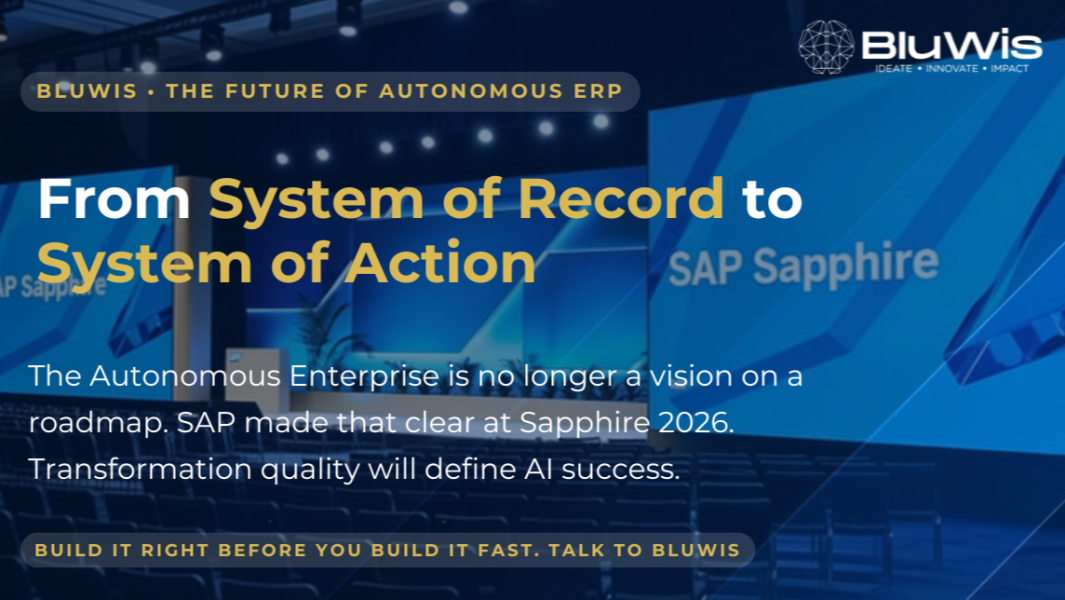
For decades ERP platforms served primarily as systems of record. They captured transactions, standardized business processes, and provided visibility into enterprise operations. SAP's Autonomous Enterprise vision introduces a new operating model where ERP systems increasingly become Systems of Action capable of recommending, orchestrating, and supporting business execution through AI. This is not simply a product enhancement—it is a fundamental architectural shift that changes how organizations design, govern, and operate enterprise technology.
From Vision to Reality
At SAP Sapphire 2026, announcements around SAP Joule, SAP Business Data Cloud, Agentic AI, and autonomous workflows demonstrated that the focus is moving beyond AI assistants toward intelligent execution. Instead of asking users to interpret reports and manually trigger actions, future enterprise platforms will help coordinate workflows, surface recommendations, automate routine decisions, and support measurable business outcomes.
Why Most Organizations Are Not Yet Ready
Although the vision is compelling, many SAP customers are still modernizing ECC environments, reducing technical debt, improving data quality, and moving toward SAP S/4HANA. Fragmented integrations, inconsistent governance, and legacy customizations continue to limit AI readiness. Systems of Action cannot deliver their full value without modern operational foundations.
The Evolution from Systems of Record to Systems of Action
Traditional ERP systems recorded information after business events occurred. Systems of Action continuously combine enterprise context, trusted data, AI, automation, and governance to support real-time operational execution. This evolution enables organizations to move from reporting toward intelligent action while maintaining enterprise control.
Clean Core Enables Systems of Action
Clean Core is no longer simply a technical recommendation. It provides the extensible architecture required for AI innovation, easier upgrades, better governance, and scalable enterprise automation. Organizations that invest in Clean Core today create a stronger foundation for future Systems of Action.
Business Data Cloud as Strategic Infrastructure
Enterprise AI depends on trusted enterprise data. SAP Business Data Cloud helps create a governed information foundation where operational context can be shared securely across applications. This enables AI to generate more relevant recommendations while reducing duplication and improving consistency.
Agentic AI and Intelligent Execution
Agentic AI extends beyond conversational assistance. AI agents can coordinate workflows, retrieve business knowledge, recommend actions, and support enterprise teams within defined governance boundaries. Organizations should begin with low-risk operational scenarios before expanding autonomous capabilities.
Building AI Readiness
Preparing for Systems of Action requires more than deploying AI tools. Organizations should strengthen governance, master data quality, testing maturity, enterprise architecture, cybersecurity, operational ownership, and cross-functional collaboration. AI readiness is ultimately an organizational capability rather than a software feature.
A Modernization Blueprint
Successful organizations increasingly adopt Clean Core by design, invest in trusted enterprise data, modernize integrations through SAP BTP, embed governance early, introduce intelligent automation selectively, and measure success through business outcomes instead of technical completion alone.
Conclusion
The transition from Systems of Record to Systems of Action represents one of the biggest changes in enterprise technology since the introduction of modern ERP platforms. Organizations that modernize responsibly, establish trusted data, embrace Clean Core, and operationalize AI through governance will be better positioned for the Autonomous Enterprise. At BluWis Technologies, we believe the future belongs to organizations that build resilient operational foundations before scaling enterprise AI.
Key Takeaways
· ERP is evolving from Systems of Record to Systems of Action.
· Clean Core is foundational for AI readiness.
· Business Data Cloud supports trusted enterprise intelligence.
· Agentic AI should be introduced through governed operational use cases.
· Modernization success will increasingly be measured by AI readiness and business outcomes.
Frequently Asked Questions
What are Systems of Action?
Enterprise platforms that move beyond recording transactions to intelligently orchestrating workflows and supporting execution.
Why is Clean Core important?
It reduces technical debt and creates a scalable architecture for AI innovation.
What is SAP Business Data Cloud?
A governed enterprise data foundation that supports AI reasoning and operational intelligence.
How should organizations begin?
Focus on Clean Core, trusted data, governance, and selective AI adoption before scaling autonomous operations.